
CI Fixer
Main is red. An agent is already on it.
When CI fails on your default branch, a Factorik agent reads the failed job's log, finds the cause and opens a pull request that fixes it. On a pull request, it tells the author what broke and how to fix it.
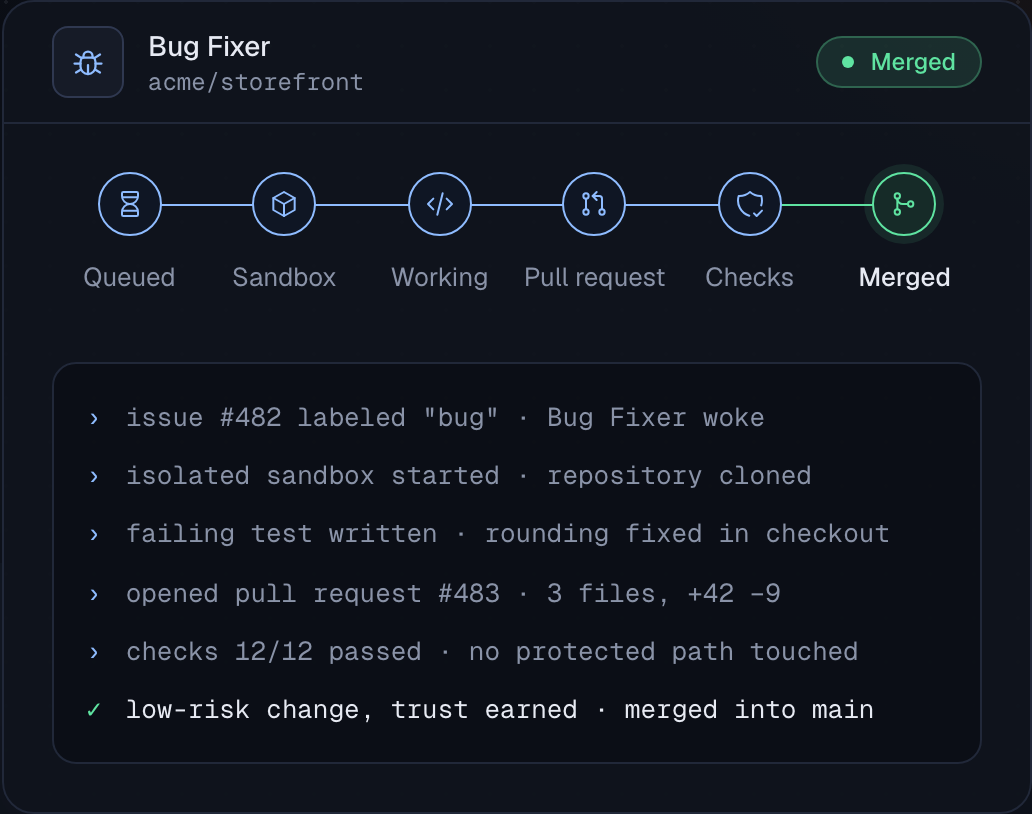
From a red build to a fix, step by step
1. CI fails on the default branch
The failure wakes the CI Fixer. No one has to notice the red badge, open the log and start digging.
2. It reads the log it was handed
Factorik reads the end of the failed jobs' log and puts it in the agent's task, so it starts from the actual error, not a guess.
3. It finds the cause in an isolated sandbox
The agent checks out the repository in a sandbox of its own, reproduces the failure and works out why it broke: a real bug, a changed dependency, a broken test.
4. It opens a pull request with the fix
Factorik publishes the change on a branch it names and opens the pull request. A person merges it, or the agent does once it has earned that and the merge policy allows.
A broken build, handled two ways
| Step | By hand | With the CI Fixer |
|---|---|---|
| Who notices | Whoever looks at main next | The failure itself starts the agent |
| Where the work starts | Scrolling a long log | The failed log's tail is already in the agent's task |
| What you get | Someone's afternoon | A pull request with the fix, or a clear comment |
| Who merges | A person | A person, until the agent earns the right and your merge policy allows it |
On someone else's pull request, it explains. It never pushes.
Your teammates' pull requests
When CI fails on a pull request from one of the repository's own branches, the agent checks it out, finds the cause and comments what to change. The author stays in charge of their branch.
An agent's own pull requests
When CI fails on a change an agent made, that agent fixes it on the same branch, a limited number of times. Then a person takes over.
Failures that were already there
Every run is told how CI stands on the default branch, so an agent never mistakes a failure that was already on main for one it caused.
Forks are left alone
Pull requests from forks are never checked out: their code would run next to your organization's AI credential.
Safe by design, not by promise
The sandbox never writes to GitHub. It gets a short-lived token that can only read one repository; what the agent changed is read out of the sandbox and published by Factorik as one commit on a new branch, never forced and never straight onto main.
Every agent starts at the first level: it opens pull requests and a person merges them. It earns the right to merge small, low-risk changes on its record, and any problem traced to one of its merged changes moves it down a level at once. Auto-merge is off until you turn it on, and it always requires passing checks.
Questions about the CI Fixer
Which CI does it work with?
It works with CI that reports its results on GitHub, which is the only git host Factorik supports today. The agent reads the failed jobs' log that GitHub returns.
Will it push to my branch?
No. On a teammate's pull request it only comments the cause and the fix. It only pushes to branches Factorik opened for its own changes.
What if the failure is flaky or not in the code?
The agent says so instead of forcing a change. A run can end with no action, or blocked with the reason and who needs to act.
Can I start it by hand?
Yes. Run now takes the default branch's latest failure. While CI passes on main, there is nothing for it to fix and it says so.
Does it need access to my secrets?
No. It reads the repository with a short-lived read-only token and the CI log Factorik hands it. It never gets write access to GitHub.
Keep main green without giving up control
Free for 7 days on the Team plan. No payment details needed.