
Autonomous engineering agents
Agents that ship pull requests, and earn the right to merge them
Define an agent once: its job, its GitHub repository, its rules. It wakes on an issue, a failed build, a pull request or a schedule, works in an isolated sandbox and opens a pull request. It merges on its own only when its record says it should.
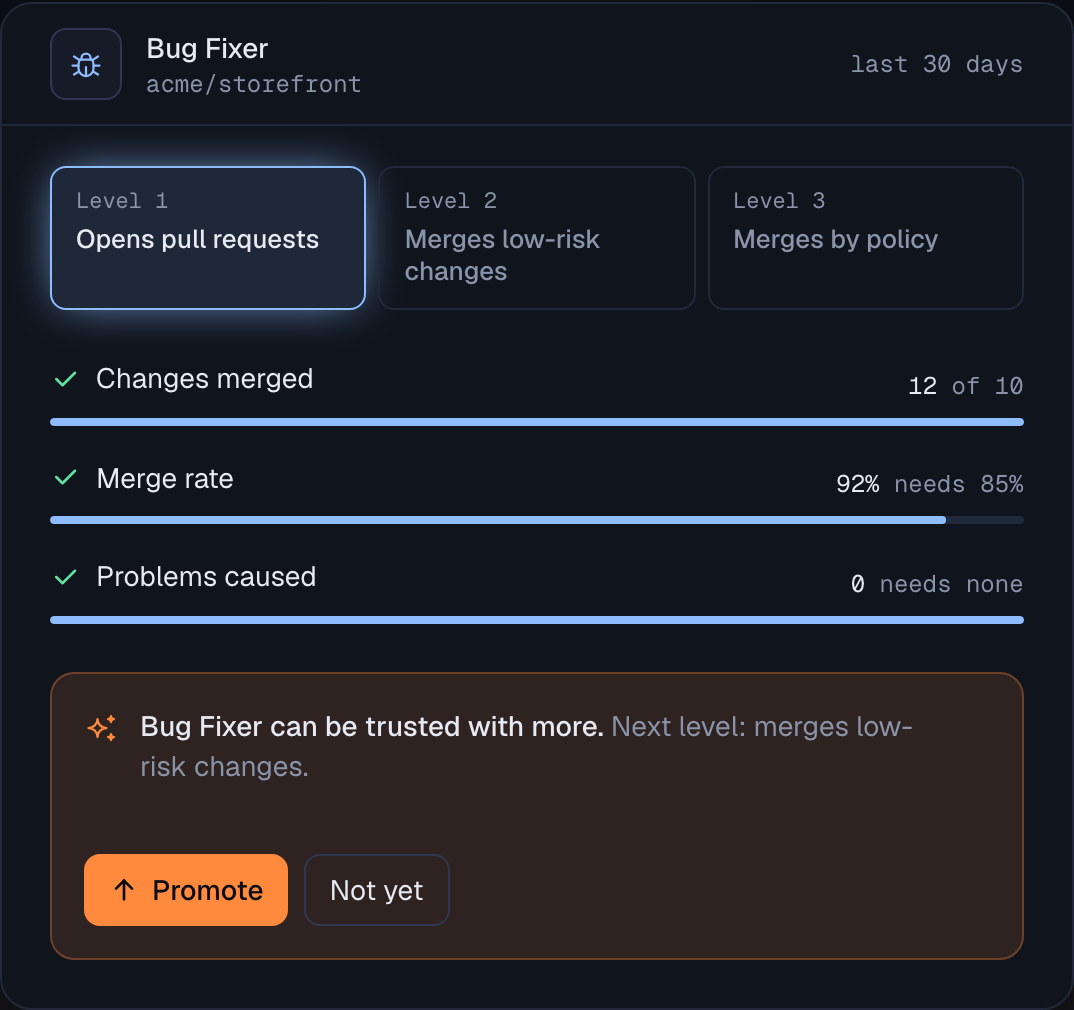
Trust that grows with evidence, and shrinks at once
Opens pull requests
Every agent starts here. Each pull request it opens waits for a person to merge it.
Merges low-risk changes
Small changes that touch nothing sensitive merge by themselves when your merge policy allows. Low-risk is decided from facts about the change, never from an AI's opinion.
Merges by policy
The agent merges whatever your repository's merge policy allows.
Moved down on a problem
A failed deploy, a revert or a reported problem on one of its merged changes drops the agent a level at once, and every change of level is recorded with why.
Three ways to let agents into your repository
| Question | Review everything | Trust everything | Earned autonomy |
|---|---|---|---|
| Who merges | Always a person | Always the agent | A person first; the agent as it earns it |
| Review load | Grows with every agent | None | Falls as low-risk changes merge on their own |
| When something breaks | Caught in review, slowly | Found in production | Recorded, and the agent moves down a level at once |
| Sensitive code | Reviewed | Unprotected | Protected paths always wait for a person |
Start from a job your team keeps postponing
Bug Fixer
Diagnoses a reported bug with your production tools, fixes the cause and proves the fix.
CI Fixer
Repairs a broken default branch; on a pull request, explains what broke.
Code Reviewer
Reviews every pull request and gives a verdict on the exact commit.
Dependency Updater
Updates outdated or vulnerable dependencies, one safe group at a time.
Test Writer
Finds important logic with no test and covers it.
Change Watcher
Checks a merged change in production and says whether it held up.
Built so a hijacked agent can do little harm
The sandbox never writes to GitHub. It gets a short-lived read-only token for one repository, and Factorik publishes the change as one commit on a branch it names: never forced, never straight onto your default branch.
Tool credentials for Sentry, Datadog, Jira, Linear, Postgres and the rest stay on Factorik's server, and every call goes through a gateway that records it. Text from issues, comments and Slack is treated as data, not instructions, and people outside your team do not start agents on a public repository unless you allow it.
Questions about autonomous coding agents
What wakes an agent?
An issue opened or labeled, a comment that mentions it, CI failing, a pull request opening, a watched change merging, a schedule, a webhook from any tool, a Slack mention, or Run now.
Will an agent merge code without me?
Not at first. Every agent starts by opening pull requests that a person merges. Automatic merging is off by default and only happens once the agent has earned it and your merge policy allows it.
How does an agent get promoted?
When its record of merged changes clears the bar, Factorik offers the promotion and a person presses Promote, or it happens automatically if your organization chose that.
Which AI does it use?
Runs use your organization's own AI provider credential, stored encrypted and read only when a run starts.
Which git hosts are supported?
GitHub today.
Let an agent earn its place on your team
Free for 7 days on the Team plan. No payment details needed.