
Code Reviewer
Code review that decides, not just comments
A Factorik agent reviews every pull request, including the ones other agents open. It runs the change, reads it in context and ends with a verdict on the exact commit it read. Nothing merges automatically until every reviewer approves the current commit.
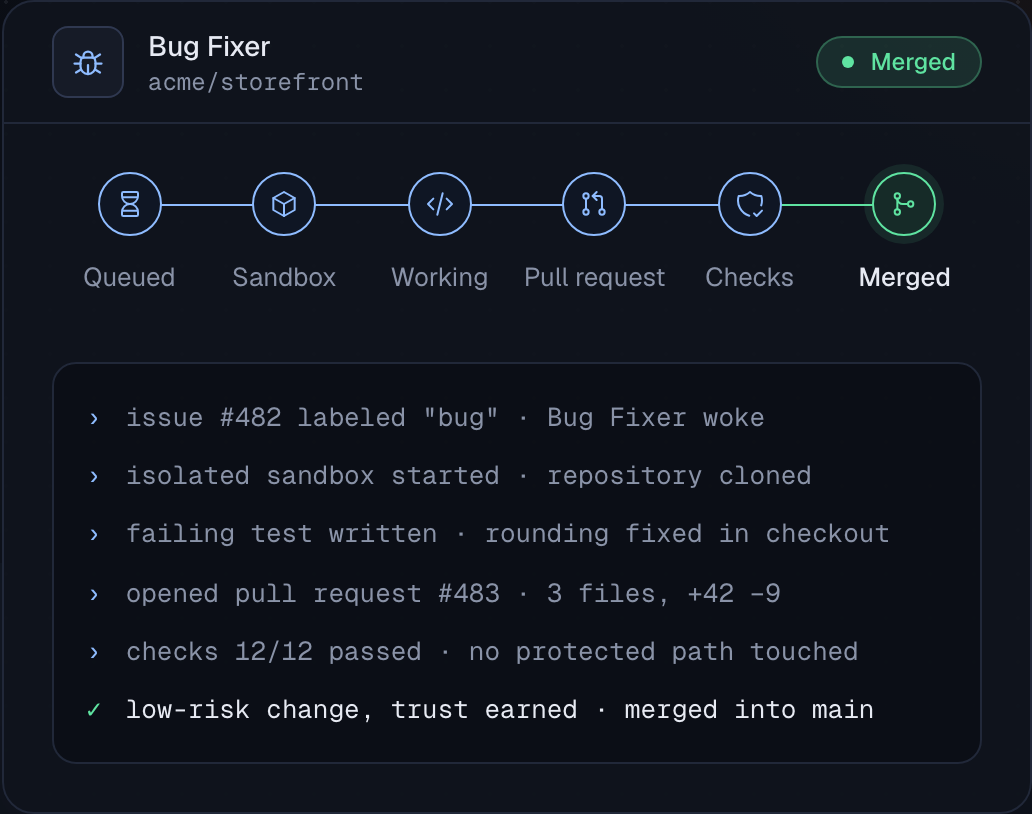
A review loop with an end
1. A pull request opens
Opening a pull request wakes the reviewer. It checks the branch out in an isolated sandbox and runs it, not just reads the diff.
2. A verdict on one commit
The review ends with approve or changes requested, tied to the commit it read. Push again and that verdict no longer counts for the new commit.
3. The author answers
When the reviewer asks for changes on an agent's pull request, the author agent answers on the same branch: it fixes each point or argues it.
4. A second look, then a person
The reviewer looks again. After a limited number of rounds, a person decides, so a disagreement never loops forever.
Review comments vs a review that gates
| What changes | Comment-only AI review | Factorik's review loop |
|---|---|---|
| Output | Comments people may skim | A verdict: approve or changes requested |
| Tied to | The pull request in general | The exact commit it read |
| What happens next | Up to whoever reads it | The author answers each point, then a second look |
| Effect on merging | None | Auto-merge waits for every reviewer's approval of the current commit |
| Final say | Unclear | A person; their approval can override |
Less waiting on review, without lowering the bar
Agents review agents
When agents open more pull requests than people can read, a reviewer agent takes the first pass on every one of them.
People review what matters
Changes that touch protected paths, such as migrations, auth or billing, always wait for a person, whatever the agents say.
It learns your standards
Every run reads the team's standing rules and recent feedback, so reviews follow how your team actually works.
Safe with outside code
Pull requests from forks are never reviewed: their code would run next to your organization's AI credential.
Review is a gate, not a suggestion box
Auto-merge is off by default. When you turn it on, a change merges by itself only if its checks pass, it touches no protected path, every reviewer approved the commit being merged, and the agent that wrote it has earned that level.
The reviewer runs in an isolated sandbox with a short-lived read-only token for one repository. It can read and run the change; it can never push to anyone's branch or merge anything itself.
Questions about AI code review
Does it replace human review?
No. It takes the first pass and gates automatic merges. People still decide anything sensitive and any disagreement the review loop cannot settle.
Does it review pull requests from people too?
Yes. It reviews every pull request on its repository. Only an agent's own pull requests get the author's answer and a second look; on a person's pull request, the person answers.
What happens if I push after an approval?
The approval was for the commit it read. Auto-merge waits for an approval of the current commit.
Can a person overrule the reviewer?
Yes. A person's approval overrides the agent's verdict.
Which git hosts are supported?
GitHub today.
Review every pull request. Merge only what earned it.
Free for 7 days on the Team plan. No payment details needed.